
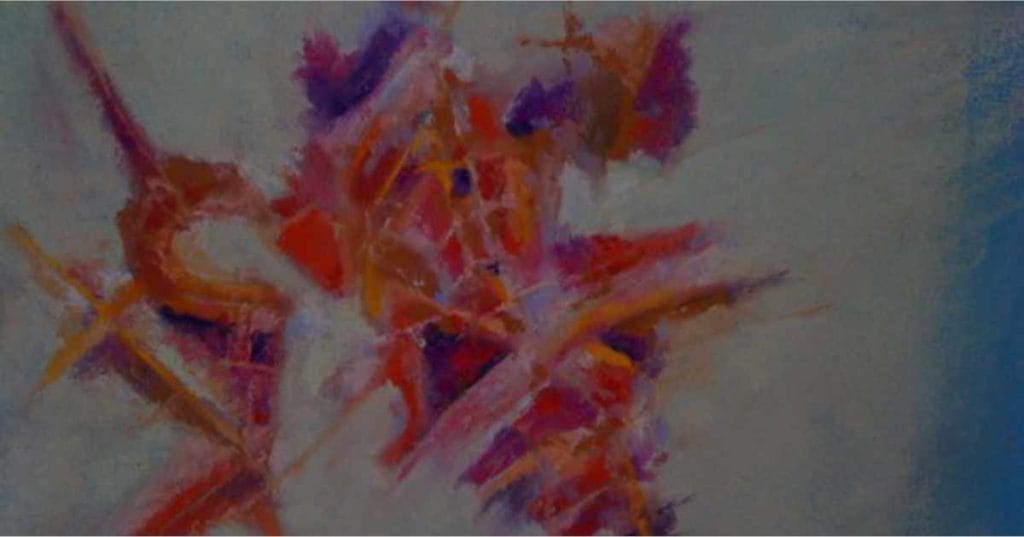
Although I am primarily a figurative artist, I have had an admiration and fondness for Abstract art. The main problem, and I would think not uncommon amongst figurative artists, is that I have had great trouble producing a piece of Abstract Art with which I am entirely happy.
Over the years however, I have come to realise that one can use recognisable images as a springboard to producing acceptable non-representational art. Observing the works of Abstract Artists one can imagine that some of their starting points were recognisable images.
During lockdown I have been completing a jigsaw of Kandinsky’s “Yellow, Red and Blue” and it became obvious to me that there is a representation of a human head on the left side of the painting.

Equally that great Neoplasticist, Piet Mondrian, must have drawn influences of the grid system and traffic lights of metropolitan New York to complete his “Boogie Woogie” pictures.

Some years ago, as part of an examination project, I became acquainted with the work of Mark Bradford who constructed collages and paintings influenced by the Street maps of his native Chicago, such as a piece entitled Kryptonite.
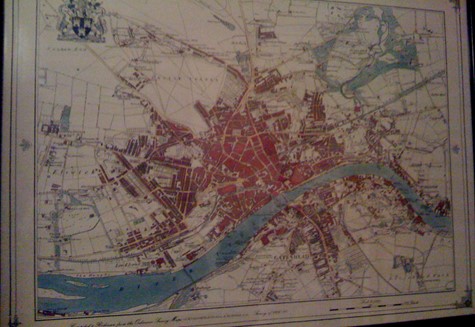
This gave me the idea to use maps as a starting point in making abstract art. I identified the places that I have lived during my married life and obtained images from framed maps and more importantly Google Earth in order to ‘Abstract’ them.
It was important that the completed picture should not be recognised as a map and so I established a number of guidelines. The first was that any reference used should be in black and white which was important when the images contained stretches of countryside and landscape and easily copied.
The next was to deliberately avoid colouring that hinted at the original image. A useful way here was to analyse the picture and use the complementary colour. From the photography I then identified broad lines that could be roads or watercourses and these became the basis of the new painting.
The final thing was not to include everything in the photo but to narrow the images in and around those prominent lines. I found my work produced some very reasonable abstract pictures and the whole experience has helped me in my further art and I may say my figurative painting.
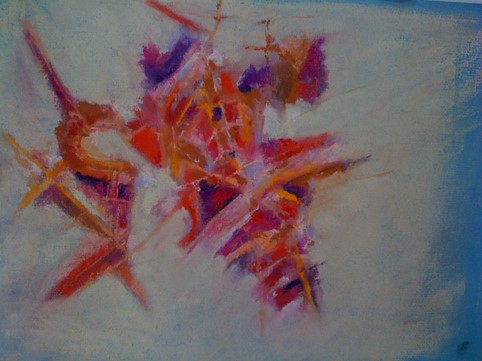
Amongst my work I am presenting a pastel painting that was based on an old map of central Newcastle upon Tyne and one can see the way in which I have followed my rules. I have changed the colouring and stripped the map down to depict a few interesting roads before experimenting with the surrounding areas. I hope this may help overcoming obstacles in producing a piece of abstract art.

8 comments
Alisa Semones
Very interesting concept for stimulating abstract composition. I loved this blog and will give this idea a try. Well done!
Ali Berrett
A very interesting subject. I am primarily an abstract artist but the images I create are usually embedded in a subject, often landscape or sea, so some would say these are not entirely abstract. Howard Hodgkin used to dispute the description of him as an abstract artist because he said his work was about feelings and responses to particular situations. I am interested in where our abstract images come from, if not from some subject. I am sure there are many connections with our psyche too. Good subject to talk about!
Lucy Brangwin
Painting in abstract forms is not something I have ever tried as I didn’t know where to start. But your explanation has made total sense and is fascinating. I love that you are using maps and places you have lived. Great blog.
Kay+Cullen
I really enjoyed your blog Stuart. Your take on Newcastle is great. Your idea of using complementary colours really works!
Susan Bjerke
Perfect blog!
Lyn Evans
That was a super blog.
I’ve been playing with abstraction and like you, found a great way to begin was to use the initial shape of an object as a starting point. Wish I’d read your article last year, would have saved a lot of time.
Many thanks.
Lyn Evans
Nigel
Ace blog Stuart – plus I’ve now actually got round to looking up what neoplasticism is, Id heard the term but never actually knew what it was. Thanks, Nigel
Stuart Walton
I hope this might stimulate you in looking closer at Mondrian. He is one of those artists who though his lifetime constantly evolved in his painting moving through Classicism, Impressionism, cubism and his abstract pictures evolved until he finally ended up with his Boogie Woogie pictures. If you ever get a chance to go to Holland make a trip to The Hague and in the Gementermuseum you will find the full spectrum of his development. Absolutely fantastic.
The very last picture he was developing is Victory Boogie Woogie and to get up,close and see his working process was mind blowing.