

Do you like surprises? Do you embrace moments of serendipity and happy accidents? “Confetti Pastels” can add to your excitement.
Many pastellists regularly save their leftover pastel dust and bits and pieces of broken pastels. These leftover bits can be reconstituted into new pastels. When all the bits are crushed and mixed together, a grey is created. But I have chosen to customize my options.
I collect and sort my bits into old medicine bottles, sorted loosely by color: cool grey, warm grey, blue grey, blue, blue/green, green, purple, yellow/orange, pink, and warm. These are relative terms as the collected bits vary over time.
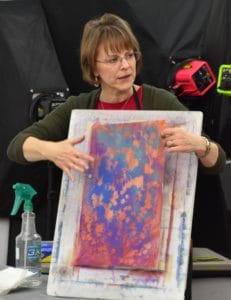
While many pastellists fully pulverize the bits before reconstituting them with distilled water, I choose to leave small intact pieces within each mix. This results in little pops of color within each “new” pastel stick.
The pastel stick will not only be a custom color, but when a mark is placed on the paper little surprises of color are left behind. It creates the illusion that multiple pastels were used, creating a dance of color. I call this celebration of color “Confetti Pastels.”
I was recently challenged to create a painting using only my collection of Confetti Pastels. I jumped at the opportunity.

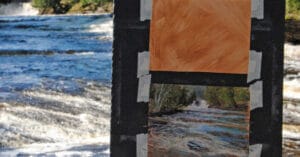
Knowing that I would have a limited palette of available pastels, the resulting painting would not be approached as a local color copy of the reference photo. The reference photo would serve only as an inspiration for the composition, while focusing on value and warm/cool relationships.

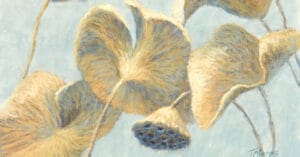
The result of this challenge is “Blessing.” (11×14”)

Viewed from a distance, this painting appears to have been created using regular pastels. But viewed up close, little accents of color dance throughout each mark.

Celebrate the surprises of Confetti Pastels and invite the viewers of your paintings in for a closer look.







6 comments
John Slater
I have been using Pastels for about 45 years and have never been successful creating a pastel out of my pastel leftovers. I grind them very small
but they always fall apart, I am missing something. One thing is I would rather be painting than making Pastels which I now leave to the professionals.
Tracey Maras
John, I totally understand leaving the making of pastels to the professionals. More than a few times I’ve ended up with reconstituted pastels that were too soft and crumbly, a mushy mess, or too hard. There’s definitely an “art” to it, and actually a lot of trial and error. When adding a few drops at a time, using an eye dropper, of distilled water to the pastel dust, I use a palette knife to slowly knead the pastel and water together. If I add too much water, it becomes a sticky mess that I must just let totally dry out and start over again. But if I take my time and add just a few drops of water at a time, I can work the pastel into a paste, comparable to a thick icing. Then, while wearing plastic/latex gloves, I roll the paste into a ball and then roll it into a cylinder shape (or sometimes a rectangle if I want more edges). I then let the pastel dry for a few days. If you are having difficulty with the reconstituted pastels crumbling, try adding a couple of drops of skim milk, as I referenced in Louise’s inquiry. Or enjoy your time painting and leave the making of the pastels to those awesome artisans at Unison Colour Pastels.
Louise Hennigs
Thanks for this very informative blog. I’m fascinated by reconstituting pastel bits and collected dust. You mention using distilled water but what else is used to bind it together, if anything?
Many thanks, Louise
Tracey Maras
Thank you Louise. Distilled water is generally recommended. Tap water can be problematic because of the presence of chlorine, which may potentially effect the colors/hues of the pastels. But in reality, there is probably so little chlorine that you likely will not see any change in the pastel you create. If you attempt making a pastel from dust that has been gathered from really, really soft pastels, you may find that the pastel will not hold together. There may not be enough residual binder in the pastel dust to bind the dust particles into a solid form. If this occurs, a couple of drops of skim milk can serve as a binder. No more than a couple of drops. Too much skim milk and the pastel stick will become almost too hard to use. Have fun experimenting!
Louise Hennigs
Thank you so much Tracey, I will try it, just out of curiosity . Nothing can compete with a real Unison pastel!
Tracey Maras
You are right about that Louise! The consistency of that buttery feel of Unison pastels and those colors are hard to beat. With the exception of “Blessed” that I created for this challenge, I tend to reserve my Confetti Pastels for those moments when I am looking for some surprises. When I want little unexpected pops of color. And they are a great way to make use of broken pastels or leftover dust, which is a conscientious approach to using materials. But there is nothing like a brand new stick of Unison Colour Pastel!