
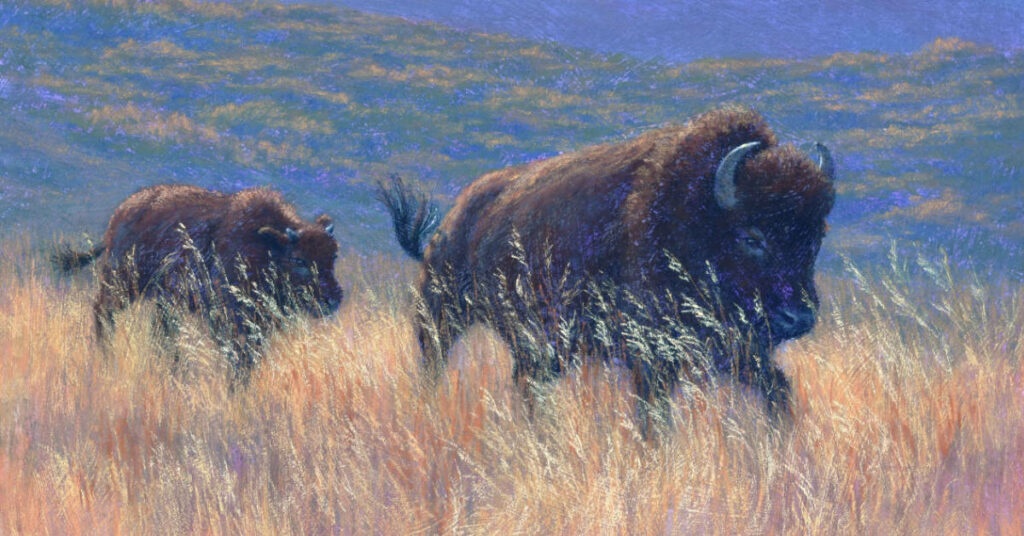
The question that every artist hears at some point is “How long did it take you to paint this?”. It can be a very complex question to answer. Is the inquiry to determine the financial value of the piece? Does the answer somehow determine the quality of the painting? Or is it a question presented by a fellow artist who is interested in the process?
What further complicates the answer is do you simply calculate the number of hours actively engaged in applying pastel to paper? Or do you include the time it took to come up with the idea, gather research and reference materials, create preliminary designs, obtain materials, prep the materials, the framing, the promotion and marketing, the number of years it took you to achieve your level of mastery, and on and on?
To be honest, some of my paintings come together like I am floating leisurely upon a lake. And some are like battling my way through a jungle. And some are like discovering the lake only after trudging through the jungle.
In answer to the question “How long did it take to paint ‘Morning Romp’?” I would have to answer, “6 years.”
Six years ago, while visiting the Grand Tetons National Park, I captured a photo of an adult and a juvenile bison running across the plains as part of their daily morning “stampede.” The backlighting by the morning sun accentuated the drama of the scene. However, the bright highlights and the dark fur of the bison caused the camera to silhouette the bison into solid black shapes. Even attempting to use photoshop editing to lighten the silhouettes to capture some sense of color and form failed. While I had many other reference photos of adult bison, I had none of juveniles.

My hopes for a painting sat unfulfilled for 6 years. However, in that time, my skills as an artist improved. My knowledge of composition, textural mediums, underpaintings, color theory, and mark-making expanded.
And then it happened. While camping in Kentucky, I was able to visit a herd of captive bison at a state park. And there were youngsters! I made several visits to the herd for photos and videos in a variety of lighting situations. Now I had the critical information that I needed. And I found that I was much better prepared to tackle this painting with the skills that I had developed over intervening years.
So, how long did it take to paint “Morning Romp”? It’s a complicated answer.



4 comments
Melanie
Thank you Tracey Maras, brilliant blog post that will resonate with so many.
I thought I was alone in this struggle. You highlight the point that artists need to value our time and planning/prep work. I guess it is part of the sense of wonder that people think it is a quick flourish of pastel to paper.
Tracey Maras
Thank you Melanie. None of us are alone in this journey. We just need to give ourselves permission to be patient with ourselves. As with any skill, we all begin as beginners. Then it is a process of learning and improving. And it is a lifetime of learning, which make it all the more exciting.
Arild Frisnes
Great subject, what you do is not easy. It requires years of practice and understanding. All that comes together in a painting. Lovely pastel also.
Tracey Maras
Thank you Arild. You are correct. Just like any skill, it takes study, practice, and patience, all while trying to retain the joy of the process.