
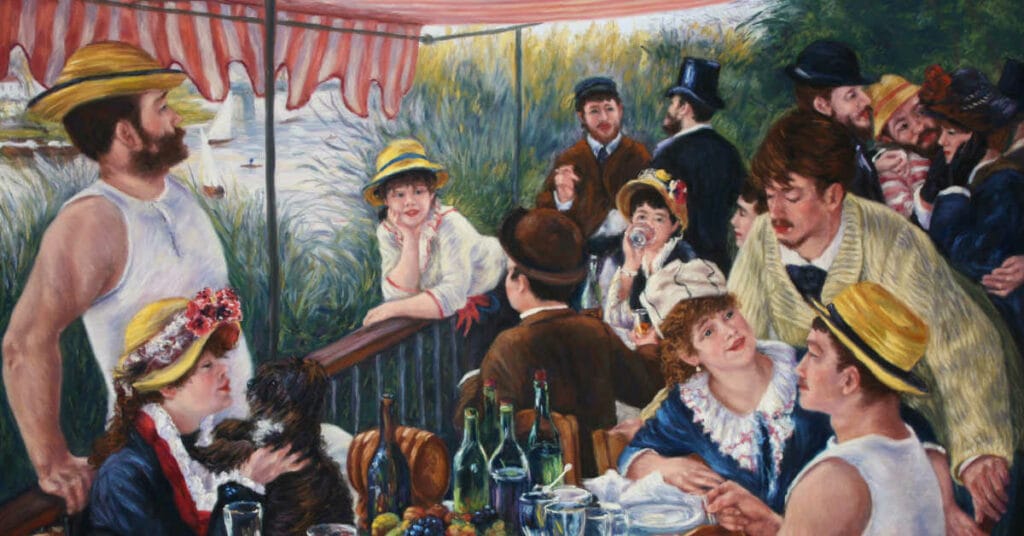
Being married to a talented artist, Catherine Inglis, has given me a wonderful appreciation for soft pastels. I am also a great admirer of the Impressionist Movement and in particular Pierre-Auguste Renoir. Some 25 years ago I asked my wife to paint a copy of a Renoir so that I could enjoy it every day at home. Pressures of a busy work schedule have meant that it has taken a Pandemic before my request has been fulfilled.
I chose one of Renoir’s best known paintings “Luncheon of the Boating Party” as the picture I would like. This is definitely not the easiest of paintings to copy. I am absolutely delighted with the finished result. The fresh vibrant colours of Unison Colour Pastels have produced a fabulous “3D” effect to the finished copy and it feels like you can walk into the scene.
It has been well worth the long wait and the picture now has pride of place in our dining room.
Ron Inglis
Luncheon of the Boating Party – Stages
Stage one

I have made my initial drawing working with a grid to scale the image from reference photo to paper using a pastel pencil. The surface I use is 800p grade sandpaper.
I follow by loosely blocking in and underpainting the composition with Conte Carre hard pastels. This is something I do with all my portrait work.
You can clearly see the colour temperatures used here as well as the tonal values.
Stage 2

I continue to build up with Conti as well as introducing softer pastels too, mostly I use Unison Colour pastels which are my favourite.
I have underpainted with black for the darkest areas and then worked over with coloured darks. Black (like white) on its own can be rather flat.
I do also confess to having been carried away by the lady in the middle ground, I couldn’t resist doing a little extra on her face! NOT something I would advise my students. Develop overall if you can.
Stage 3 & 4

I continue to work developing overall in the composition. Starting to work up the flesh areas a little more and also blend the pastel with the fingers. I feel it is easier to work these lighter areas at this stage rather than constantly switching from dark to light. This avoids contamination of pastel residue. A good idea is to use an old cotton cloth to keep both pastels and fingers clean as you are working.

I rarely use blenders but find the Conti pastels great for moving softer pastel around. On the sanded paper they will adhere for detailed work too.
Stage 5

This is really about the finer details, especially the table and its contents.
The fun thing was making the sparkles on the wine glasses shine out, and bright pastels are best for this. Remembering darks make the lights lighter and of course the opposite works too. I love the colours and tones in Renoir’s painting. I think he is the most talented of artists.
I have so enjoyed completing this copy of his most famous work and I certainly feel that I have learned a great deal.
I think Ron is thinking of commissioning another…….!
Note from the Artist

Lockdown finally gave me time to work on this request from Ron. He was adamant it was to be reproduced in pastel and not oils as Renoir’s original had been painted. I must say after thoughts of “where do I start” I really enjoyed the challenge that stood before me on my easel.
Working on this image for so many hours made me realise what an amazing master Renoir was. The way he has grouped his friends, how the eye travels through the painting and the perfect ratios of dark and light create such a wonderfully composed piece.
The painting has a very interesting history which can be found by looking on this link.
https://en.wikipedia.org/wiki/Luncheon_of_the_Boating_Party
I felt to have learnt from this – an artist never stops learning.



26 comments
Judy Turner
What a wonderful version of Renoir’s painting! Is it the square Conte carre sticks that you use for your underpainting?
Sian Chatfield
It’s really beautiful!! Not that I’m surprised
Наталья Белянская
(Translated)Great copy! This is a very bold decision to do the job with pastels! How thrilling! I made copies with oil, but not with pastels. You inspire feats!!! Cath, you are a talented and brave artist! Thanks to the Unison team for getting to know modern geniuses!
(Original)Великолепная копия! Это очень смелое решение выполнить работу пастелью! Потрясающе! Я выполняла копии маслом, но не пастелью. Вы вдохновляете на подвиги!!! Кэйт, вы талантливый и смелый художник! Спасибо команде Юнисон за знакомство с современными гениями!
Cath Inglis
My goodness I am not a genius. I have had an awful lot of practice and that is a big thing! Of course having wonderful pastels as well counts a lot too. Thanks so muc .
michele
wow it’s an amazing painting. Very good and love to see the stages.
Cath Inglis
Than you Michele
Dianne
Fabulous.
Cath Inglis
Thank you Dianne
Stanislas Renoir
Well done.
Cath Inglis
Thank you so much.
Cath
Gwynydd Deakin
An amazing piece of work you must be so proud of yourself. I’ve watched several of your videos on other subjects and have found them so helpful and inspiring. I must try using hard and soft pastels (particularly Unison) with each other. Good luck on your next masterpiece.
Cath Inglis
Hi Gwynedd
Thanks so much. Indeed you must as the Conte hard pastels work so well with Unison Pastels.
David Medhurst
What a wonderful piece of work. Thank you so much for posting the various stages and descriptions as you worked through the project. Ron is married to a very talented lady !
Cath Inglis
Thank you David , this was a very interesting challenge to work- Ron loves it!
Margaret Whiteoak
Absolutely wonderful Cath, the detail is fabulous and just as good in pastel as in the original oils. A family heirloom to treasure for many years to come
Cath Inglis
Thank you Margaret for your appreciation.
John A Root
Wonderful work. I love the looseness, and yet the fine details where necessary. So well done. I am wondering what the size is. Is it on paper or panel?
Cath Inglis
Hi John
The image size unframed is 71cms x 52cms
It is painted on an 800p sanded paper which hold lots of pastel. I do have this for sale to pastel artists who like to use this.
So pleased too that you liked the piece it was a challenge.
Anabella Cortes
Amazing work. Renoir would have been proud of your work. He is one of my favorites too.
Cath Inglis
Thank you so much Anabella
Anneli
A brilliant piece of work and so inspiring to see the various stages of her
Method.
Catherine Inglis
Thanks Anneli. I really enjoyed working this piece. I love his work and would have loved to see how the master himself worked on it – I believe it was many months in the working.
Jean Stewart
Am amazing piece of work so much tiny detail too and l bet if the Artist were still alive he would applaud you.
Catherine Inglis
Thanks Jean for such a lovely comment.
Cath
Ali Fife Cook
It’s amazing, and what I’ve noticed is that the detail of the background water, and the items on the table, draw my eye, whereas the original seemed to be more about the people. Not that the people aren’t good, they really are, but for me there seems to be more to the picture in this version.
Catherine Inglis
Thank you Alfie, the table with all the contents certainly was a challenge.
Cath