
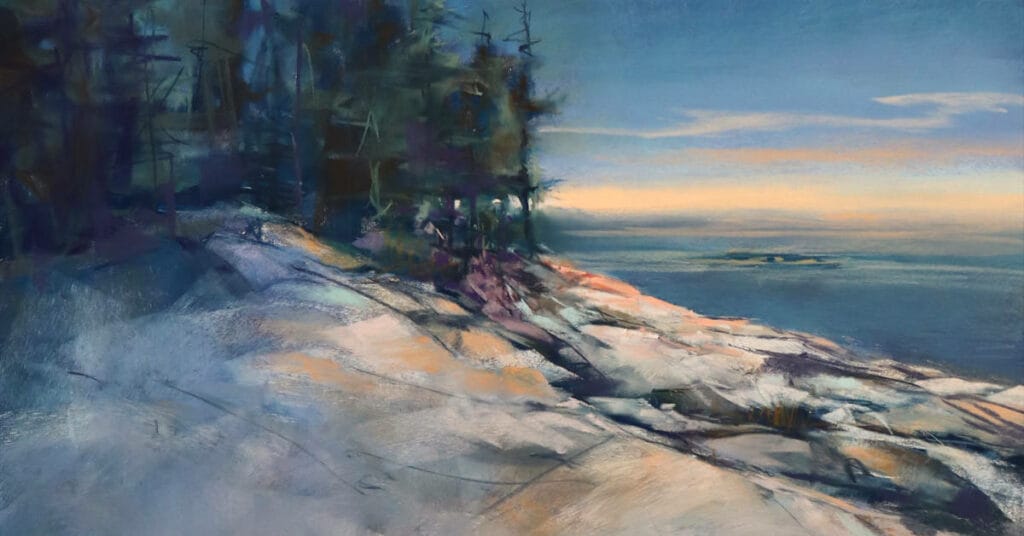
Touch. How often do we think about it as we paint? As a pastel painter, touch isn’t just about the feel of the materials or the hand of the papers used, or the delicious textures created by the soft, buttery pigment that accumulates on the surface of a painting. It’s also about pressure and finesse, the speed of a mark – whether it’s made slow or quick; touch is about heavy and light, a decisive stroke against the surface we’re working on or a timid one.

Many years before I began painting with pastel, I worked as a calligrapher. I spent years listening to the scratch of metal nib, eventually knowing the “sound” of the line as I laid ink onto paper. I trained my hand to apply pressure and release it, changing the width and movement of a line from thick to thin, from bold to subtle, from curved and sinuous to straight and taut. Not only did I learn to manipulate pressure on the pen nib to create nuances in those strokes, but I retain the muscle memory of those gestures to this day.

One of my favorite things about being an Associate Artist for Unison Colour is the long distance interactions I have had via Zoom with their wonderfully curious Artist Relations Managers. In a recent conversation, while talking about the act of painting with a stick of pigment rather than with brushes, I realized that the lessons I learned as a calligrapher apply directly to my current painting practices all these years later. Having often heard the term “calligraphic marks” used in reference to the marks I make in my paintings, I initially thought only of the movement and gesture and “look” of those marks, but this particular conversation made me consider that the description encompasses more than that.

Manipulating a pastel stick turns out to be very similar to manipulating the nib of a dip pen. With pastel, one must get to know the materials, the different types and brands of pastels, and one must learn the surfaces of the papers, just as a calligrapher would learn the different nibs and inks and writing surfaces.
In this way, the act of creating art always reminds me of what it must be like to have the ability to play an instrument well… the musician must know her instrument intimately, just as we must know our materials intimately. She must work to learn the potential of that relationship between her hands and their ability to sense, through touch, the reactions that her instrument will have, just as we learn the unique properties of a stick of pigment or the nib of a pen, and how those materials will react in any given situation. With pastel, we work until the feel of a stick on paper becomes like an extension of our fingers, and we get to know exactly how that pastel stick will perform under any circumstance.

A mark’s potential lies in our ability to “feel” the way we create that mark. It lies in our sense of touch, our ability to manipulate the gesture and pressure of a mark and our materials.
And so, it’s imperative that we learn how our own hand works. The pressure that my hand employs to apply a Unison Colour pastel to a piece of UART 400, for example, will be different from the pressure of your hand. Even if we try to make exactly the same mark with the same pastel stick, that mark will be different because there are a myriad of reasons why our hands are different.

Becoming familiar with whether we are inherently “heavy handed”, or whether we naturally have a “light touch” is important. Once we have become familiar with the unique way our own hand moves, we also become more able to regulate the push and pull of making marks with the sticks we hold in our fingers, and we become more sensitive to the mark-making possibilities of each unique stick of pigment. Even within one brand, sticks tend to have different hardnesses and softnesses dependent on the properties of the pigment itself.

Consequently, if we work to learn how to deftly manipulate a pastel stick by getting to know our own sense of touch, our choices will become far less limited and our mark-making will become more personal and unique and varied.
It’s all in the way we apply pastel to a surface, and that begins with the push and pull of the stick. It’s about the way our hand learns to control the materials to create a mark. In the end, it’s all about touch, and the way we train our hand to adapt to our materials and to feel it’s way through the painting process.




6 comments
Michele
Absolutely Brilliant! Your work is lovely! Reading the blog and the knowledge of such an accomplished artist is very appreciated. Expanding on some of the important facts as to why those abilities are important to and how they helped with your path to successful painting with pastels is priceless… Have they ever! Wow! Your working amazing. I think I heard between the lines…Practice often!…. but not sure..lol. Very encouraging for someone like me still learning. I have many unison pastels sets, will be buying more soon and may dig out my old calligraphy pen just for fun. Thank you so much for writing very helpful and inspiring!
Time to paint.
Michele
Lyn
Hi Michele,
Yes! Practice often! And in all ways! All the art you’ve ever made has contributed to where you are right now as an artist!
Phil Amos
An excellent blog, Lyn, with a powerful message that encourages me to be mindful of “touch” when applying pastel. I always look forward to your “Saturday at the Cove” newsletter.
Lyn
Many thanks, Phil!
Tracey Maras
Lyn, your description of how we each have our own inherent mark-making “touch” explains beautifully the rationale for embracing our own individual style. Developing our skills in incorporating a variety of mark making is desirable to keep our paintings engaging and interesting. But embracing our personal style keeps our work unique. Thank you for explaining this so eloquently, as are your paintings!
Lyn
Thank you, Tracey! It’s so important for all of us to remember that our own work will always reflect our own individual style. No matter what we experiment with or try to change, our own unique way of applying pastel to paper will come through!